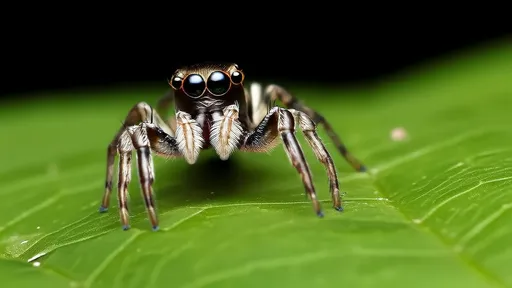
In the intricate world of arthropod predation, few hunters demonstrate the precision and computational brilliance of jumping spiders. These eight-legged acrobats, belonging to the family Salticidae, have evolved an extraordinary ability to calculate complex ballistic trajectories mid-leap—a skill that puts most vertebrate predators to shame. Unlike their web-spinning cousins, jumping spiders rely on keen eyesight, rapid neural processing, and an internal "ballistics computer" to ambush prey with terrifying accuracy.
What makes these millimeter-sized predators truly remarkable is their capacity to solve spatial problems that would challenge even advanced robots. Before launching into a parabolic arc, a jumping spider assesses distance, adjusts for gravity, compensates for air resistance, and sometimes even plans detours around obstacles—all within milliseconds. Recent high-speed camera studies reveal that they frequently alter leg positioning during flight to correct their trajectory, suggesting real-time course adjustments comparable to guided missiles.
The secret weapon in this arachnid's arsenal lies behind its two enormous front eyes. These high-resolution lenses provide depth perception through a unique retinal structure that moves independently of each other, creating a form of biological rangefinding. Meanwhile, secondary eyes detect motion across nearly 360 degrees, alerting the spider to both prey and potential threats. This visual system feeds data to a specialized neural network that processes spatial relationships at speeds making supercomputers seem sluggish by comparison.
Laboratory experiments demonstrate that jumping spiders don't merely jump toward movement; they formulate sophisticated attack strategies. When presented with prey at varying elevations, the spiders consistently adjust their takeoff angle and force to intercept targets midair. Even more astonishing, they can memorize complex pathways to ambush prey they've temporarily lost sight of—a cognitive feat previously thought impossible for invertebrates with such small brains.
Their hunting technique reveals an elegant fusion of physics and physiology. By altering the hydraulic pressure in their legs, jumping spiders can modulate leap intensity with micrometer precision. Specialized silk lines, though not used for web-building, serve as safety harnesses during ambitious attacks. The spiders' exoskeleton contains elastic proteins that store and release energy like coiled springs, allowing explosive jumps without muscular buildup.
Neuroscientists have identified specialized ganglia in the spider's brain that function as biological analog computers. These neural structures continuously calculate velocity vectors, accounting for the predator's mass, the prey's movement patterns, and environmental variables. The system operates so efficiently that jumping spiders successfully capture prey in 80-90% of attempts—a success rate that humbles big cats and birds of prey.
Recent breakthroughs in micro-robotics have drawn inspiration from these arachnid mathematicians. Engineers attempting to replicate the spiders' trajectory-calculating abilities have struggled to match their energy efficiency and processing speed. The spiders achieve their feats while consuming less power than a digital calculator, using neural architectures fundamentally different from silicon-based computers.
As research continues, scientists uncover ever-more sophisticated aspects of the jumping spider's hunting algorithm. Some species demonstrate the ability to "lead" moving targets—predicting future positions based on prey velocity. Others modify attack strategies based on prior experience, showing primitive learning capabilities. This combination of hardwired brilliance and behavioral plasticity makes salticids a prime subject for understanding the evolution of cognition.
Beyond their scientific significance, jumping spiders challenge our anthropocentric views of intelligence. Their ability to perform advanced calculations without a cerebral cortex suggests that nature has developed multiple solutions to complex problem-solving. The next time you see a jumping spider pause before pouncing, remember—you're witnessing one of evolution's most finely tuned ballistic computers in action, packaged in a body smaller than your fingernail.

By /Jun 10, 2025

By /Jun 10, 2025

By /Jun 10, 2025

By /Jun 10, 2025

By /Jun 10, 2025

By /Jun 10, 2025

By /Jun 10, 2025

By /Jun 10, 2025

By /Jun 10, 2025
By /Jun 10, 2025

By /Jun 10, 2025
By /Jun 10, 2025

By /Jun 10, 2025

By /Jun 10, 2025

By /Jun 10, 2025