The Bombardier Beetle: Nature's Master of Chemical Warfare
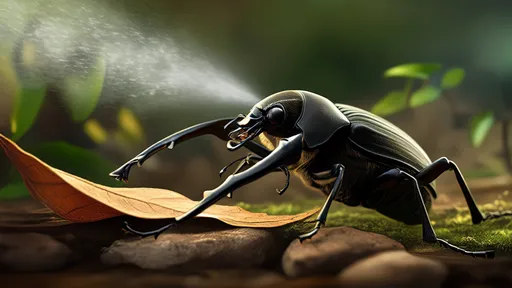
In the hidden corners of forests and grasslands, a tiny insect executes one of nature's most precise and violent chemical attacks. The bombardier beetle, often colloquially called the "fart beetle," doesn't just release noxious fumes—it weaponizes them with the accuracy of a military-grade flamethrower. This unassuming creature has evolved a defense mechanism so sophisticated that it continues to baffle scientists and inspire engineers.
The bombardier beetle's secret lies in its abdomen, where two separate chambers store hydroquinones and hydrogen peroxide. When threatened, these chemicals mix in a third chamber lined with enzymes that trigger an explosive reaction. The resulting boiling, toxic spray erupts from the beetle's rotating abdominal tip with a distinctive popping sound, reaching temperatures of 100°C (212°F) and accurately targeting predators like ants, spiders, or even curious humans.
Evolution's Arms Race
This remarkable adaptation didn't emerge overnight. Over millions of years, the beetle's ancestors gradually developed this system through incremental improvements. Early versions likely produced simple irritating secretions, but through natural selection, the mechanism became increasingly complex. The modern bombardier can fire up to 20 pulses per second, adjusting the direction of its spray nozzle with precision that puts industrial spray systems to shame.
What makes this defense truly extraordinary is its controlled detonation. The explosive reaction could easily rupture the beetle's own body, yet through a combination of timed muscle contractions and reinforced chamber walls, the energy gets directed outward in harmless (to the beetle) bursts. This pulsating delivery system prevents backpressure from building up to dangerous levels—a solution that took human engineers decades to replicate in industrial applications.
The Chemistry Behind the Blast
At the molecular level, the beetle's weapon system operates like a well-choreographed dance. When the hydroquinones and hydrogen peroxide combine in the reaction chamber, the enzyme catalase breaks down the peroxide into water and oxygen. Another enzyme, peroxidase, then oxidizes the hydroquinones into benzoquinones. This two-step process generates tremendous heat and gas pressure—the driving force behind the explosive ejection.
The benzoquinones serve dual purposes: they're both toxic to predators and act as surfactants that reduce the spray's surface tension. This allows the boiling liquid to spread effectively upon contact, maximizing damage. Some species have even developed specialized chemical cocktails tailored to their primary predators—a form of biochemical warfare customization that would make military strategists envious.
Engineering Inspiration
Biomimicry researchers have studied the bombardier beetle's mechanism for potential applications in everything from fire suppression systems to drug delivery. The beetle's pulsating ejection method offers solutions to problems of controlled detonation that have plagued engineers for years. Some prototype spray systems now replicate the beetle's sequential micro-explosions to achieve more efficient fuel combustion or precise medication dispersal in inhalers.
Perhaps most remarkably, the beetle's chemical production facility operates continuously without poisoning itself—a feat that industrial chemical plants struggle to achieve. The separation of reactants until the moment of use, the built-in cooling systems, and the fail-safe ejection mechanisms all represent evolutionary solutions worth studying for human technology.
Ecological Implications
In the complex web of predator-prey relationships, the bombardier beetle occupies a unique niche. Its defense is so effective that few creatures risk attacking it, creating a kind of chemical force field. Some predators have learned to recognize the beetle's distinctive shape and avoid it altogether, while others attempt attacks from specific angles to avoid the spray. Certain parasitic wasps have even evolved to attack from the front, immobilizing the beetle before it can rotate its abdomen into firing position.
The beetle's success has led to the proliferation of numerous mimic species—insects that copy its warning coloration without possessing the chemical defenses. This phenomenon, known as Batesian mimicry, demonstrates how profoundly the bombardier beetle has influenced its ecosystem. Its very existence has shaped the evolutionary trajectories of countless other organisms.
Human Encounters
For entomologists studying these creatures, fieldwork comes with occupational hazards. A startled bombardier beetle can accurately hit a researcher's face from several inches away, delivering a painful lesson in chemical defense. The experience leaves victims with temporary skin irritation and an unforgettable smell—described as a combination of burning plastic and rancid iodine—that can linger for hours.
Yet these encounters only deepen scientists' respect for the mechanism. Modern imaging technologies have revealed that the beetle's spray nozzle contains microscopic grooves that help direct the explosive bursts. High-speed footage shows how the beetle can adjust its aim mid-burst, tracking moving threats with unsettling accuracy.
Unanswered Questions
Despite extensive study, mysteries remain about how the beetle's system evolved in stages. The intermediate forms between simple defensive secretions and the modern explosive apparatus would have been vulnerable to failure—what evolutionary pressures maintained these partial systems until they became fully functional? How does the beetle precisely control the chemical ratios to prevent catastrophic misfires? These questions continue to drive research at the intersection of chemistry, biology, and physics.
The bombardier beetle stands as a testament to nature's ingenuity—a creature that has mastered controlled explosions long before humans discovered gunpowder. In its tiny abdomen lies a chemical weapons factory more sophisticated than anything in human arsenals, operating at microscopic scales with flawless precision. As both a marvel of evolution and a source of technological inspiration, this unassuming insect reminds us that some of nature's most advanced engineering comes in very small packages.

By /Jun 10, 2025
By /Jun 10, 2025
By /Jun 10, 2025

By /Jun 10, 2025

By /Jun 10, 2025

By /Jun 10, 2025

By /Jun 10, 2025

By /Jun 10, 2025
By /Jun 10, 2025
By /Jun 10, 2025
By /Jun 10, 2025
By /Jun 10, 2025

By /Jun 10, 2025

By /Jun 10, 2025

By /Jun 10, 2025