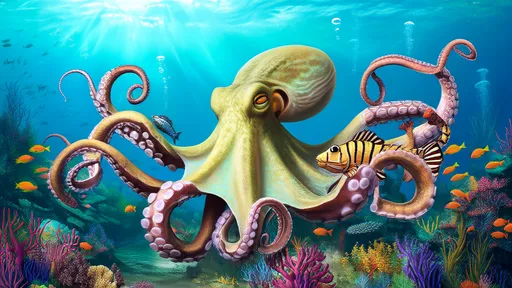
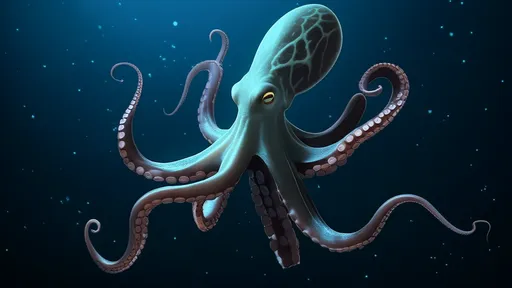
The ocean’s depths hold countless mysteries, but few are as visually mesmerizing as the cephalopod’s ability to change color in the blink of an eye. Among these masters of disguise, the octopus stands out—not just for its intelligence, but for its otherworldly capacity to shift hues, patterns, and even textures. For years, scientists believed this transformation was solely controlled by the creature’s nervous system. Recent discoveries, however, have unveiled a far more intricate mechanism: light-sensitive cells embedded directly in the octopus’s skin, capable of detecting and responding to light independently of the eyes or brain.
This revelation challenges long-held assumptions about how cephalopods perceive and interact with their environment. Unlike most animals, which rely on centralized organs like eyes to process visual information, octopuses appear to possess a decentralized sensory network. Their skin is not just a canvas for camouflage but an active participant in the process, equipped with opsins—the same light-sensitive proteins found in human retinas. These proteins allow the skin to "see" light in its immediate surroundings, triggering rapid color changes without waiting for signals from the brain.
The implications of this discovery are profound. If an octopus’s skin can independently detect and react to light, it suggests an evolutionary adaptation unlike anything seen in vertebrates. Researchers speculate that this system may have developed as a survival mechanism in the deep sea, where split-second reactions to predators or prey could mean the difference between life and death. Imagine a creature whose very skin acts as a distributed sensory organ, capable of blending into a coral reef or a rocky seabed before its brain has even registered the threat. It’s a level of biological sophistication that borders on science fiction.
One of the most striking aspects of this phenomenon is its speed. Octopuses can alter their appearance in milliseconds—far faster than any neural signal could travel from the eyes to the brain and back to the skin. Early experiments involved exposing octopus skin samples to different light conditions, and the results were startling. Even when isolated from the central nervous system, the skin responded to changes in light by adjusting its pigment cells, or chromatophores. This localized control system explains how octopuses achieve such rapid and precise camouflage, but it also raises new questions about the limits of decentralized intelligence.
What makes this system even more remarkable is its precision. Octopuses don’t just match the color of their surroundings; they replicate intricate patterns and textures, mimicking everything from algae-covered rocks to drifting seaweed. Studies suggest that the skin’s light-sensitive cells may work in tandem with the chromatophores, creating a feedback loop that fine-tunes the animal’s appearance in real time. This isn’t a blunt, one-size-fits-all response—it’s a dynamic, context-aware adaptation that rivals the most advanced human-made technologies.
Beyond camouflage, these discoveries could reshape our understanding of sensory perception. If an octopus’s skin can "see," does that mean it experiences the world in a way we can’t even conceptualize? Humans rely on a centralized brain to interpret sensory data, but cephalopods may operate on a radically different model, where perception is distributed across the body. This raises philosophical questions about the nature of consciousness and whether intelligence must always be rooted in a single, controlling organ.
The practical applications of this research are equally tantalizing. Engineers are already looking to octopus skin as inspiration for adaptive materials that could change color or texture on demand. Imagine military camouflage that adjusts to its environment without external power, or medical implants that respond to light for targeted drug delivery. The octopus’s natural technology has evolved over millions of years, and we’re only beginning to unravel its secrets.
Yet, for all our fascination, the octopus remains an enigma. How does its decentralized sensory system integrate with its highly developed brain? Do other cephalopods, like cuttlefish or squid, possess similar capabilities? And what other sensory functions might be hidden in the skin of these creatures? Each answer leads to new questions, reminding us that the natural world is far more complex—and far more wondrous—than we often assume.
As research continues, one thing is clear: the octopus’s ability to "see" with its skin is not just a biological curiosity. It’s a window into an entirely different way of being, one that challenges our assumptions about perception, intelligence, and the very boundaries of the self. In the end, the octopus may teach us as much about ourselves as it does about life in the ocean’s depths.

By /Jun 10, 2025

By /Jun 10, 2025
By /Jun 10, 2025
By /Jun 10, 2025
By /Jun 10, 2025
By /Jun 10, 2025

By /Jun 10, 2025

By /Jun 10, 2025
By /Jun 10, 2025

By /Jun 10, 2025
By /Jun 10, 2025
By /Jun 10, 2025
By /Jun 10, 2025

By /Jun 10, 2025
By /Jun 10, 2025